Saturday, 8 March 2014

Snowstorm Casualties

Spring is waking up the world in the Pacific Northwest.  Snowdrops and aconites have been blooming for weeks now and crocuses are joining in the mix.  Narcissus buds will soon be opening and at this time of the year we always look forward to the sight of 2 ancient yellow plum trees in the orchard vivid with white blossoms.  But this will likely be the last year for that.

We live in a bare-land strata of 13 owners with privately-held land and 22 acres of common property.  Part of that common land is a very old orchard.  The original settlers on this property were a family of 4.  The 1911 Census lists father, mother and 2 sons.  The father gave "farmer" as his occupation.  The orchard must date back to that time making the trees at least 100 years old.

Yesterday when walking to the beach with our grandson, we discovered that the recent snowstorm had brought down both yellow plums.
One tree is completely down.
The second tree is resting on one branch.
Snow in this part of the world tends to be heavy and wet.  It's easy to see how the dense canopy would hold a lot of snow.  The aging structures would be no match for the weight.
Intertwined branches make a dense canopy
The trees are still alive and one might survive but would be badly weakened.  The other will have to be removed.  Every Spring for the 20+ years we've been living here we have marvelled at their beauty and I've tried many times without success to capture the vision with my camera.  We will sorely miss these ancient trees.

Friday, 28 February 2014

Never Doubt

No seeds have thrust above the potting soil yet, but spring is definitely on the way.
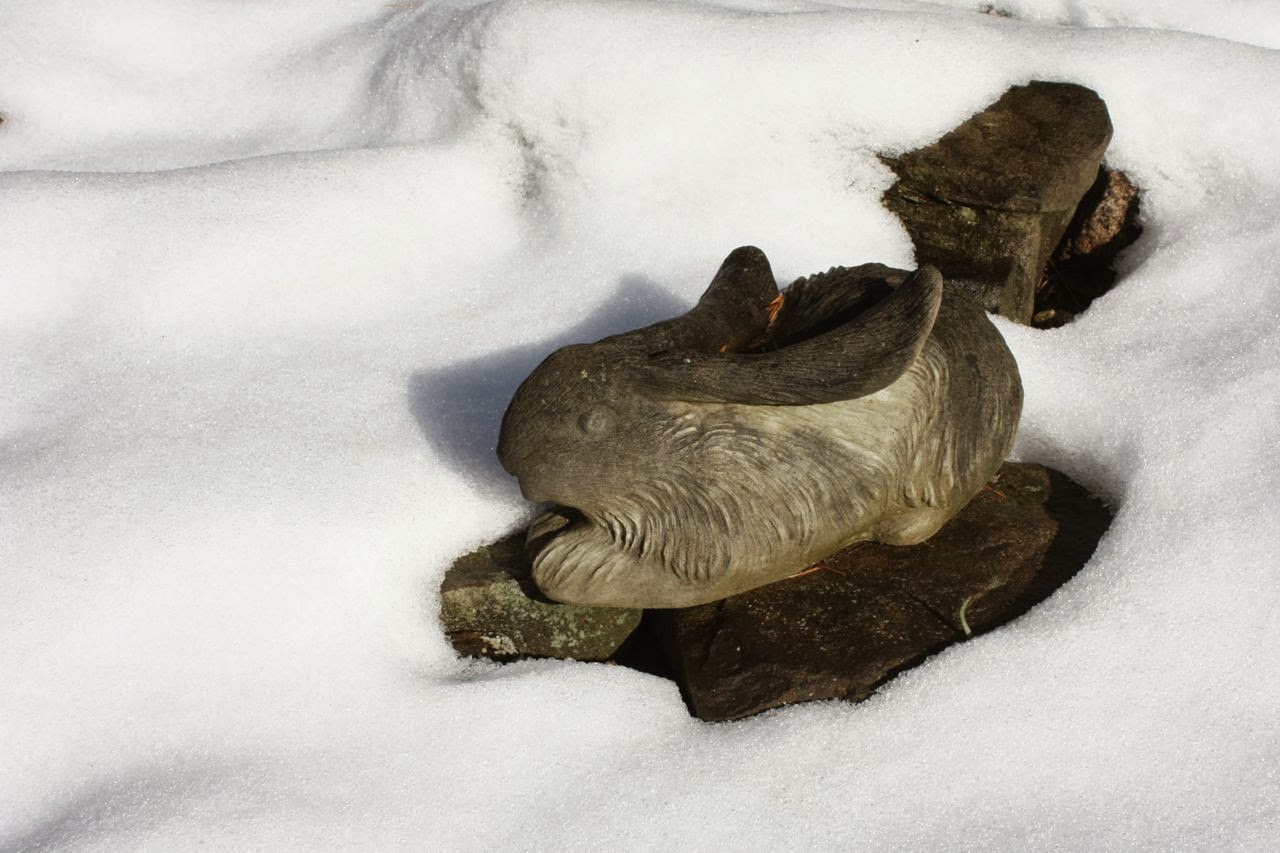
Concrete he may be, but rabbit is ready to break free of the snow.
Self-seeded Bright Lights Swiss Chard makes it through the snow unscathed and ready for picking.  This vegetable has been brightening up our meals right through the winter.
Aconites and snowdrops have been blooming for some time.  Narcissus has strong buds now just waiting for warmth to make them open.
Our coral bark maple is becoming more handsome with each year that passes and really comes into its own in the early spring when the young branches live up to its name.
Several piers japonica shrubs are sporting cascades of blossoms at this time of the year.
King Edward Flowering Currant blossoms emerge to warn us that Rufous Hummingbirds will soon be here to join the stalwart Anna's Hummingbirds which have been with us all winter.   Spring is truly peeking around the corner!

Wednesday, 26 February 2014

It must be spring!

The aftermath of our snow storm which knocked out power twice.
I don't care what the weather is outside or the fact that the ground is covered with snow from our recent snow storms.  It simply has to be spring because today I started seeding! I have a small amount of seeding mix left but not enough for all the seeding I had to do.  I filled the bottoms of the pots with potting mixture and the tops with the fine seeding soil mixture.  Make do!
Leeks, onions, kale and lettuce will all germinate in the potting shed
Today I started the following:

Kale - Improved Siberian and Redbor
Lettuce - Black Seeded Simpson, Red Sails and Drunken Woman
Onions - Copra
Leeks - Bandit

These pots will stay in the potting shed as they don't need the heat to germinate.  They will be protected, however, with a plastic dome.
Seeding done
Tomatoes - lots of these!
Cherry - Gold Nugget, Sweet Million, Sweet Baby Girl and Principe Borghese
Plum - Health Kick and Classica

These pots are now under lights in the house.  Tomatoes need the heat to germinate but can take cool once they're up.  I've seeded 11 of the Health Kick as I've promised plants to friends and family but I plan on keeping at least 4 for myself.  Classica is a new hybrid variety that I thought I'd try.  Both are from T&T Seeds.  Not sure how many Classica I'll have as the pot tipped over and I lost some of the soil!  If I just have a couple, I'll be happy.  I'll look for a plant or two for slicers.
Tomatoes under light in the living room
It'll be at least another month before anything else gets planted, but in the meantime, I need to go through all my seed packages, note on the front what gets planted when and sort them in the seed box my husband made for me.  As far as I'm concerned - it's spring!


Friday, 31 January 2014

The Seeds Are Here!

Seeds for the 2014 Garden

So that must mean that spring is fast approaching.  At least I'll tell myself that.  It's the end of January and there's still a lot of winter left.

I ordered seeds from T & T Seeds this year as they carry Health Kick Tomatoes.  I ordered 2 packages of them in case they're hard to find next year.  In addition, I'm trying out another paste tomato, Classica.  Just to finish off, I ordered a package of Pink Swirl Impatiens from the Super Elfin series.  Every garden needs some flowers and these will be great in pots around the pond.

The West Coast Seeds order is, of course, the big one and they had everything I asked for:

Beets - Cylindra
Carrots - Royal Cantenay and Scarlet Nantes
Corn - Bodacious
Kale - Improved Siberian & Redbor
Leeks - Bandit
Lettuce - Drunken Woman (!), Red Sails and Simpson Elite
Onions - Copra
Peas - Oregon Sugar Pod 2
Squash - Waltham Butternut
Swiss Chard - Silverado and Bright Lights
Tomato - Principe Borghese and Sweet Million

So now the planning begins!  Today I turned over another bed and mulched the garlic which is well up.  We checked out the Three Sisters bed which is on its last legs.  We'll be able to get one more year out of it and next year it will be replaced with one long bed which will be at least 4' wide.  I also checked out the bed that has cedar roots creeping in through a crack and sure enough, there are lots!  That bed will have to be dealt with next.  Then I need to sit down and decide what will go where.  Crop rotation is important and root crops need to be followed by non-root crops.  One of the new 4x4 beds will be for potatoes - just enough to satisfy the craving for those delicious new baby potatoes!

Plans!  The bed which is growing garlic will also host some early spring planting and I'm going to try getting some lettuce going now.  I'll start it in the house and once it's up, transplant it to pots in the potting shed.  When they're strong enough, they'll be planted in the garlic bed and protected with hot caps.

In February - that's next week! - I'll start kale, leeks and onions.  Near the end of the month, I'll get the tomatoes started.  I won't grow as many as last year, but concentrate on cherries and romas.  This year I'm determined to get several batches of salsa to go with the pasta sauces.  I also want to grow some on the deck and bought some really big pots from Lee Valley last fall along with special grids to go under them to protect the deck.  They'll grow cherries tomatoes and basil.

This is the really exciting time for gardeners - planning!  Soon enough will come the hard work.

Friday, 17 January 2014

It's Spring in January

Today my mind is finally turning to the garden.  I've been studiously ignoring it all winter even though I know there are so many unfinished projects out there waiting for me.  We have had a little winter cold this year, but all in all, it's been pretty mild.  Only one snowfall which quickly disappeared.  There will be more - it's only January!  But this is what we come to expect on the West Coast - and in particular in the Gulf Islands.

Today I ordered my seeds from West Coast Seeds and T & T Seeds.  The latter was on my list because it was where I finally located Health Kick Tomato seeds.  My plea to West Coast Seeds went unrewarded!  That done, it was time to hit the garden.

I finally got the raspberries pruned and in shape.  They look very vigorous and this year I cut them about 5' tall.  Hopefully this will help to keep them in bounds.  As I headed up to the garden to dispose of the old canes I noticed that Abraham Darby (rose) is looking very fine!  He obviously is flourishing in his new home.  This rose has lost no leaves during the winter and there are even a few buds in evidence.  Then I saw how the King Edward Currant is breaking bud.  It was time to take a "spring signs tour"!
King Edward Currant buds getting ready to open
There are some plants I expect flowers from during the winter, so I grabbed my camera to take the census.
Viburnum flowers for the Anna's Hummingbirds we see in winter.
One of our viburnums (we have several varieties) starts blooming in November.  By January, it's starting to really show off its pink blossoms.
Purple Helebore
Then there's the purple hellebore that a neighbour gave me many years ago.  I planted it down below the house at the edge of the woods where it often gets forgotten.  It certainly never gets watered - or even weeded - but it seems to thrive down there and thrusts up its blossoms every year.  At this time of January, it's just getting going.
Hazelnut Catkins
We have 4 hazelnut bushes and the 2 older ones are dripping with catkins.  The 2 small ones are too young to have catkins yet, but they have a delicious secret hidden in their roots.  They've been inoculated with perigord truffle spores!  We can expect truffles in a couple of years.  When I edited the picture of the catkins (above) I notice you could make out the tiny dark pink flowers.  Look really hard - they're not easy to see!  Click on the picture to make it bigger, look where the catkin joins the branch and you'll see the flower.
Oriental Poppy
Oriental poppies are also sending up leaves at this time of the year.  This particular poppy is a pale pink one - name unknown.
Flat-leafed Italian Parsley Seedling
I've been picking herbs throughout the winter and the Italian parsley I planted a number of years ago freely sends its seeds out to create new plants.  It casts so many that I'm always pulling up plants but there are always more to help out the kitchen.
Bright Lights Swiss Chard
Tour finished, I picked a bouquet of Bright Lights Swiss Chard for tonight's dinner and headed in for a cup of tea.

Saturday, 21 December 2013

Feed the Birds!

Today is the official start of winter but we've already had a couple of little tastes.  It's pretty mild here in the Gulf Islands, however, we've had one spell of very cold weather and just recently, a bit of snow which is now melting.

There's not much happening in the garden, but our bird feeders are very busy.  We've had to put out a small hummingbird feeder for two Anna's Hummingbird females.  These hummingbirds don't migrate in winter, finding sustenance in small insects, tree sap provided by sapsuckers and the occasional brave flower.  We have a viburnum which starts flowering in November and doesn't stop until spring which must be of some help.  Still, the cold weather must take its toll on them so we help them out with sugar-water feeders.  Usually you make a hummingbird mixture 1 part sugar to 4 parts water but in the winter you can do that 1:3 for Anna's, which is how ours is set up.  Anna's look very similar to Rufous Hummingbirds.  The females are much the same coloration, but without the rusty tones of the
Rufous and they're slightly larger.  We've never seen a male, which has an iridescent red-coloured head.
Chestnut Backed Chickadees
We always have a feeder filled with black oil sunflower seeds for birds winter and summer.  We see lots of chickadees, juncos, nuthatches, towhees and purple finches in the winter.  At this time of the year we augment the feeder with a suet block.  The chickadees especially love the suet block as they're very adept at hanging upside down.  I make my own suet blocks following a recipe I found and adapted from the Internet.

Suet Blocks for Birds

1 part lard
1 part crunchy peanut butter
1 part flour
2 parts rolled oats
2 parts cornmeal
various seeds and dried fruits.

Melt the lard in a large pot.  Add the peanut butter and stir together.  Add remaining ingredients and pour into a baking pan.  Since I use a whole pound of lard, I pour the mixture into a 9x13 pan.  Allow the mixture to cool and slice into blocks.  The 9x13 pan makes 6 blocks.  Now put the pan in the freezer and leave overnight.  You can easily remove the blocks by running hot water over the bottom to just melt the outside edges of the blocks.  I place the blocks in large ziplock bags and freeze them until they're needed.

The blocks I made last week have niger seeds, sunflower seeds, pumpkin seeds, currants and dried cranberries added.  I throw in whatever is on hand and since I have quite a bit of it, I used half old fashioned rolled oats and half steel-cut oats.  I've seen recipes with sugar added.  Why on earth would you add sugar?!  It sounds totally wrong.

Thursday, 3 October 2013

Applesauce

Just as the vegetable garden is slowing down, the orchard kicks into high gear.  What to do with all the apples!  We have 6 apple trees, all fairly young.  The production wasn't stellar this year, probably things were a bit cool at the critical pollination time.  That said, however, we still have more apples than we can eat fresh.  I made a few apple crisps, and we've eaten lots.  There are still quite a few apples to deal with.  The obvious solution is applesauce which is good all on its own or used in baking - such as applesauce cake.  Check out the links for the recipes.

I had already bottled applesauce made of Gravenstein apples and had some more made up waiting to be bottled.  Today I used some Liberty apples.  The Liberty apple is a delicious tart apple for eating fresh.  It's small compared to other apples, but has dense, crisp white flesh housed in a pretty red skin.  That red skin lends a lovely blush to the applesauce.
Since I'm using my latest kitchen tool, a food mill, to process the applesauce, preparing the apples is a snap.  I quarter them, take out the seeds and chop off the dried blossom end - purely for esthetics - chop them and into the pot they go.  No need to peel or core.
I added a little water to the pot, just to keep the apples from burning, popped the lid on and simmered them slowly, stirring from time to time.  I found with the Liberty apples that I needed to add a bit of water several times.  The Gravenstein apples are much juicier and didn't need further water added.  You just have to keep an eye on them while they're cooking and judge for yourself if you need to add water.
When the apples were cooked down, I spooned them into the food mill.  This one is made by Oxo and the design is excellent.  It goes together and comes apart easily and the legs, which fold up for storage, fit over a range of bowl sizes.  It comes with 3 sieve attachments - I used the medium one.
In a minute or two, I had a bowl of thick tasty applesauce.  As both Gravenstein and Liberty apples have their own sweetness, there was no need to add sugar.  I reheated the applesauce so that I could bottle it in 1-cup jars, the perfect amount for applesauce cake.  I jarred both the Liberty applesauce made today and that of Gravenstein apples which I'd made yesterday.
It's easy to tell which is Liberty and which is Gravenstein!
The final step was processing the jars in a boiling water bath for 15 minutes.  I now have 7 more jars of applesauce to add to the 6 I did last week.  That should be more than enough for our household.