Showing posts with label watering. Show all posts

Tuesday, 10 May 2016

Corn!

Now that we are deciding that while the real estate market on Vancouver Island is hot, hot, hot, on our tiny Gulf Island, it's not, not, not, I'm becoming resigned to the strong possibility that we will be staying here for the near future.  And that's not a bad thing!  We love the peace, security and quiet of our little island and have a lot going for us here.

And with this in mind, my enthusiasm for gardening - which had cooled somewhat lately - has returned full force.  It was time to start the corn!  I start my corn in the potting shed.  This allows me to start it earlier than I would outside which is a help when growing the sweeter varieties which take longer to mature.
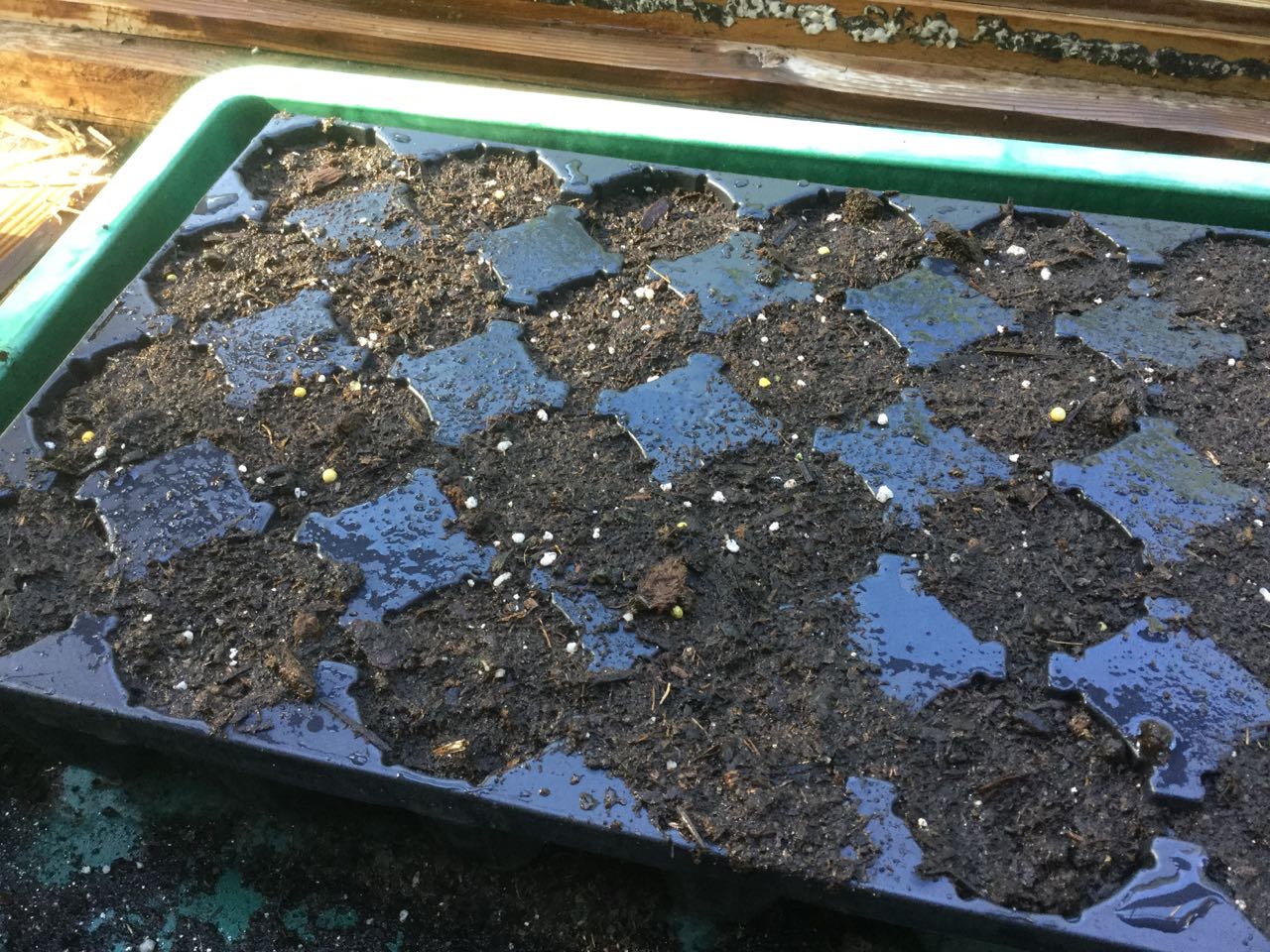
I purchased extra deep potting trays from Lee Valley some years ago, and they work really well for corn which sets long roots and doesn't particularly like them disturbed.  Each tray has 36 sections, which is enough to give us a few good feeds of corn - that's all we ask for!
I fill the corn tray with a good potting soil, shake it to settle the mix and then add a bit more on top to fill the sections.  Then I place one seed in each section and press down with my index finger to just past the first knuckle.  More soil goes on top to cover the seeds.
The tray get a good watering.
Finally a plastic lid goes on top to keep the heat in for germination.  I will wedge pots at each side just in case a mouse decides to check out my seeds.  One year I had to give up on starting corn in the potting shed as mice came in and ate every seed!

The seeds will sprout quickly and just as I'm starting to see roots popping out the bottom, I'll plant them in their new home.  A covering of Remay cloth will keep them warm until summer is firmly in place.

Corn planting done, it was time to water the rest of the garden and do a few chores.  I like the early mornings for garden work.  Watering - which I prefer to do by hand - gets plenty of time for the moisture to seep down into the soil.  I take this time to thoroughly inspect each crop and adjust care as necessary.
I planted the beans a week ago.  This year I didn't move the bean structure as we weren't sure what our status would be.  It doesn't really matter with beans as they're happy to continue building up nutrition in the soil.  We'll move it next year.  I planted the beans at the base of the structure, 5 beans to a structure wall, protected them with water bottle collars and supplied each seed with a bamboo pole to help it reach the structure walls.  And yes, I haven't removed all of last year's dead bean vines.  They will eventually break up and fall down all on their own.  I am "The Messy Gardener" after all!
This morning I could see that the bean seeds have germinated with a lively green sprout showing in nearly every collar.

Finally I potted up the 2 remaining tomato plants which are destined to go to a friend who is still away on a trip.  The plants went into gallon pots and will now live outside with the rest of my tomatoes until the friend returns and can take them.

The only plants left in the potting shed are the peppers and a basil, all of which need hotter weather before they can go outside.

Wednesday, 12 August 2015

Tomato Blossom End Rot

It's August of what is turning out to be the driest year on record.  The garden is suffering!
In spite of the deep watering I'm doing in the tomato bed, I'm seeing blossom end rot on some of the Health Kick tomatoes.
Blossom end rot
I've seen this a lot in plum-type tomatoes in my garden when they haven't had adequate water,  but Health Kick tomatoes have been better at withstanding the problem in the past.  Not this year!  I think it's because the crop is so heavy. I've never seen so many tomatoes on plants before!  Most of them are sound, but if I turn over smaller, stunted tomatoes, there's the rot starting.  I pull those ones off right away and discard them.  I know that the bed was well prepared with home made fertilizer, compost and SeaSoil, so I don't think that nutrition to the plants is the problem as it usually is with blossom end rot.  In my case, I think it's just that the crop is so huge that the plants can't keep up moisture-wise.  So I keep watering and pull off the ripening fruit and finish the ripening in baskets in my kitchen so the plants have less fruit to cater to.
Aphids
The kale is also struggling.  In the Russian Red Kale, whenever I see a leaf curling over, it's got aphids inside.  Unfortunately, it's the tender young leaves that are most affected, so today I'm going to pull up the Russian Red Kale.  Blasting the aphids off with strong water streams is not keeping the problem in check.  So far, the Lacinato and Siberian are managing to avoid it, but in this dry heat, I don't think it's going to be long before I see aphids on them as well.
Sprawling butternut squash vines
The three butternut squash planted in the compost bin have been doing their best to escape into the garden.  Every morning the vines look happy and healthy, but by afternoon the leaves are drooping.  I give this bin a good, deep watering every day and spray the leaves as well, but it seems to make no difference to the afternoon droop.
Big squashes!
Fortunately, it hasn't seemed to affect the fruit of the plants.  These have to be the biggest butternut squashes I've ever grown!  I guess the plants are putting all the energy into the fruits!
Italian heritage beans under the bean arbour
The only bed that's been able to maintain a good moisture level is the corn/beans bed.  We've had a wonderful crop of corn and its pretty much finished now, but the beans are just getting going.  They are so rampant, that I'm going to see if my husband will tie ropes from the bean arbour to the fence so the vines can have more areas to sprawl to and make picking easier.  It seems that all in all, my vision of the bean arbour is going to work.  There are beans hanging down underneath the arbour already waiting to be picked.  I'll put them in tonight's butter chicken dish!

Friday, 17 July 2015

El Nino in the Garden 2015

This is turning out to be the driest year we have experienced in the garden and many of the crops are showing stress in spite of all the water that I'm giving them.
Butternut Squash
Many crops are very early.  Strawberries were weeks ahead of time and the crops were pretty good.  The corn is loving the heat, as are the beans.  Other heat-loving plants like peppers and squash are quite happy so far, but they all need water.
Fruit trusses on Health Kick Tomatoes
The tomato plants are huge and early on set a bumper crop of fruit, but now the flower trusses are not setting.  I've had to really keep an eye on this bed because it's one of the beds that cedar roots have managed to creep into.  I hadn't realized what was happening and almost lost one Principe Borghese plant before I discovered how dry the soil was. (Update 5 hours later:  with a temperature of 28C and a strong wind, the tomato plants were losing moisture so quickly that they were starting to wilt and a second deep watering was required.)
Principe Borghese Tomatoes
In checking back, I can see that most years at this time the fruit is just starting to turn on early tomatoes.  We've been snacking on Gold Nugget and Sweet Millions for a couple of weeks now!
Corn is a heavy feeder, too, but this bed is maintaining a good quality of moisture and I think it's the tallest corn we've ever had.  I'd say we're only a couple of weeks off harvest for the corn and the Italian heritage beans haven't even started to flower yet!
Signs of aphids on the kale
Kale is a cool weather lover and it's really struggling in the heat.  I've noticed leaves are starting to curl up and there are signs of aphids starting to make their homes in the leaves.  I'm picking those off, and the kale is getting lots of water, but the heat is telling on their general health.
Harvested garlic sorted into varieties
I just finished harvesting the garlic and am quite disappointed with the size of the bulbs.  This might be because of the heat.  They reached maturity a couple of weeks early and this means that time that might have been spent growing was lost.
Copra Onions starting to fall over
This was also true for the onions.  The yellow onions have already been harvested and I'm seeing signs that the Copra plants are approaching maturity.

And this makes things difficult for the young Brussels Sprouts plants which were just transplanted.  I will probably have to rig up some sort of shade for them to carry them through to fall.

Everything else seems to be coming along well, but each day I'm out there giving the veggies a good drink.  The perennial beds have been ignored.  Water is so precious that only the vegetables and plants in pots are being catered to.  A newsletter from West Coast Seeds addressed this issue and also finished with the sobering thought that the National Oceanographic Atmospheric Administration (NOAA) is predicting that there's a 95% chance that these conditions will continue through fall - and an 85% chance that they'll go through the coming winter.  Now that's scary!

Friday, 3 July 2015

Garlic and Onions - When to Stop Watering

Each year I stew over this subject.  Onions are simpler, but when to stop watering the garlic always makes me think.

GARLIC

Garlic plants at the beginning of July
My situation is outside the norm since I'm vegetable gardening in what amounts to a giant container garden.  Not only that, but this year's extreme early heat and lack of rain makes the situation more complicated.  I've been keeping watering longer than I normally would because things are drying out so quickly.  If you stop watering too soon, the garlic won't fully develop.  If you water too long, you run the risk of the garlic splitting the skins - which I've definitely had happen in the past!  The drying foliage is only one indicator.  I've also been keeping watch by digging up a couple of bulbs.
Test bulb
Two days ago, the bulb I dug up looks to be ready.  The cloves are clearly defined under their paper wrappers.  I've therefore stopped watering the garlic which will sit in the ground for a couple of weeks before I dig it up.

I recently learned another tip in garlic harvesting.  I've always pulled up the garlic, but a recent West Coast Seeds newsletter talked about carefully digging it up so that the bulb is not harmed in any way. After the garlic is out of the ground, I always tie and hang it out of the sun to cure.  When good and dry I cut off the stems and roots, then store the bulbs in open paper bags which I put in a cupboard on an outside wall.  And of course I always save the best bulbs for planting come October!

ONIONS

This year I grew 2 varieties.  I always grow Copra which is such a good onion and keeps so well, but thinking that not enough seed germinated, I bought a bag of yellow onion sets which were planted in the same bed.
2 varieties of onions growing in the same bed
Naturally, the sets have matured much more quickly than the plants grown from seed and a week or two ago, the yellow onions started to fall over which is a sign that they're maturing.  The Copra onions are still stiffly upright and have some time yet to go so they're receiving a good watering every day.  I have now stopped watering the yellow onions and will pull them up in a day or two.  Unlike garlic, onions can be dried in the sun.
Yellow onions
I'll just leave them on the surface of the bed for a few days.  Then, I'll brush off any clinging dirt and put them on racks to finish curing in the potting shed.  When the necks are completely dry, I'll cut off the stems about 1" above the bulb and trim the roots.  Then they'll go down into our heated crawl space for storage.  I'm anticipating that the yellow onions won't keep as well as the Copra do, and we'll definitely use up these ones first.  Since the bulbs are so much smaller than Copra, it probably won't take long to use them up.

Onions and Garlic are two crops that I would always grow.  They don't require a lot of care and the yield is wonderful.  And garlic is the easiest - the major growth time occurs during the winter and spring when it doesn't even need to be watered!  There's nothing like home-grown garlic and onions!

Saturday, 20 June 2015

June in the Garden

It's been a very dry growing season so far.  Since the end of April we have had precisely 7.4 mm of precipitation.  As I noted in July 2013, I now water mostly by hand.  I used to have watering systems in place, but since our garden water comes from an irrigation pond, as the season rolls along, weed grows in the pond and chokes up the nozzles of the watering system.  Plus, I really enjoy watering by hand.  I know exactly which plants need water and it allows me to keep a watchful eye on the garden.  And it's relaxing!
Salvia Forkoahcei next to cattail rushes - it's tall!
Today while watering I was struck by a plant at the end of the pond.  Salvia Forkoahcei came from seed I purchased through Salt Spring Seeds a number of years ago.  It's a rare perennial that gets really large - almost shrublike - and has tall spikes of blue-purple flowers.  This particular bed has received no water other than the above-mentioned rain water and yet it's doing extremely well in very dry soil.  One reference I found mentioned that deer didn't like it.  It has sown little plants elsewhere and I can see that this might be a valuable plant to have in the garden!
Another view of the pond
The vegetables are the only plants that get watered in our yard, and because we are blessed with a big irrigation pond, they are well looked after.  And in the warm spring we've had, everything is doing well and ahead of where they usually are.
The bean arbour with corn in front of it.  Basil in pots
The beans are scrambling up their new arbour and the corn is growing by leaps and bounds.
Suyo Cucumber and Patty Pan Squash
In one of the 4x4 concrete raised beds I planted a Suyo Cucumber and a Patty Pan Squash.  I put a bit of fencing behind the cucumber for it to climb on.  You apparently get straighter cucumbers this way and the cucumber is definitely doing its part to scramble up the fence.
Gold Nugget Tomato truss
All of the tomato plants have fruit on them.  Gold Nugget is always the earliest to ripen in my garden,  and it won't be long until we can help ourselves to delicious sweet little tomatoes.
The celery is doing well.  I'm making sure it gets lots of water so that the stalks don't become hollow. I imagine lack of water would affect the flavour as well as the texture.

We could sure use more rain and none is in the forecast.  In the meantime, I'll keep watering by hand, observing the garden and thoroughly enjoying myself!


Saturday, 13 July 2013

Watering by Hand

I really enjoy hand watering.
Water droplets on a leaf of Russian Red Kale
Certainly there are more efficient ways to water your garden and we do have drip hoses in some of our raised beds.  Since our irrigation water comes from a pond, we use drip hoses which have drippers every 10" as weeping hoses clog up with algae.  These lines are in beds which have crops needing more and consistent water needs such as the tomatoes, onions and the Three Sisters beds.
Drip hose running through the onion bed
But there's something about watering by hand that is just so satisfying - indeed necessary.  I spend some of my best thinking time directing water to the bases of plants.  It's a good time to plan next year's garden.  Decide what has worked and what has not.  Think of other ways to improve crops and possibly what new plant you might want to try.  It also allows you time to have a good look at your crops while they're growing.  You can spot problems while they're still small such as aphids on a rosebud and monitor changes in plants like onions prematurely going to seed.

Hand watering is a peaceful occupation, a great stress reducer and a time to observe in depth the changes at work in my garden.  To me, it's not just a pleasant luxury - it's a necessity!