Showing posts with label currant. Show all posts

Friday, 27 March 2015

Potting Up

Yesterday I finally got around to potting up little transplants.  I'm growing a lot of tomato plants for friends this year and have moved the tiny seedlings out to the potting shed.  Tomato seeds need heat for germination, but once they're up, they can take some cool temperatures.  With night time temperatures starting the move up, the potting shed it the place for them so they don't become too leggy.
Tomato and pepper seedlings in their temporary new homes
I always put the transplanted tomatoes deeper in the soil.  They will create roots on the buried stem, making the plant stronger and also making them less leggy.  More detailed directions on potting up tomato seedlings can be found in a March post from last year. At the same time, I potted up pepper plants.  They've been in the potting shed for a week now and are doing well.

My big problem is with pots.  I love to give away plants, but it's leaving me a bit short of 4" and 6" pots.  I'll have to ask for some pots in return!
Victoria Celery
This year I'm growing celery for the first time.  I carefully transplanted a dozen tiny seedlings into 6-pack planters and they have all survived.  Naturally, the ones left in the starting pot are ahead of them, not having suffered the shock of transplanting.  I may set out some of those as well as there are lots to choose from.
Lettuce Seedlings
Lettuce plants are also doing very well and I'll probably be able to set them outside any day now.
Red Currant volunteer against the potting shed
Today the weather is glorious, in spite of a dismal prediction.  The blue orchard bees are starting to emerge from their winter homes and the red currant is loud with the noise of pollination.
In the pond, the water marigold is coming into full bloom.  Fish are starting to come up for food and all the aquatic plants are waking up.  Spring is definitely here!

Friday, 28 February 2014

Never Doubt

No seeds have thrust above the potting soil yet, but spring is definitely on the way.
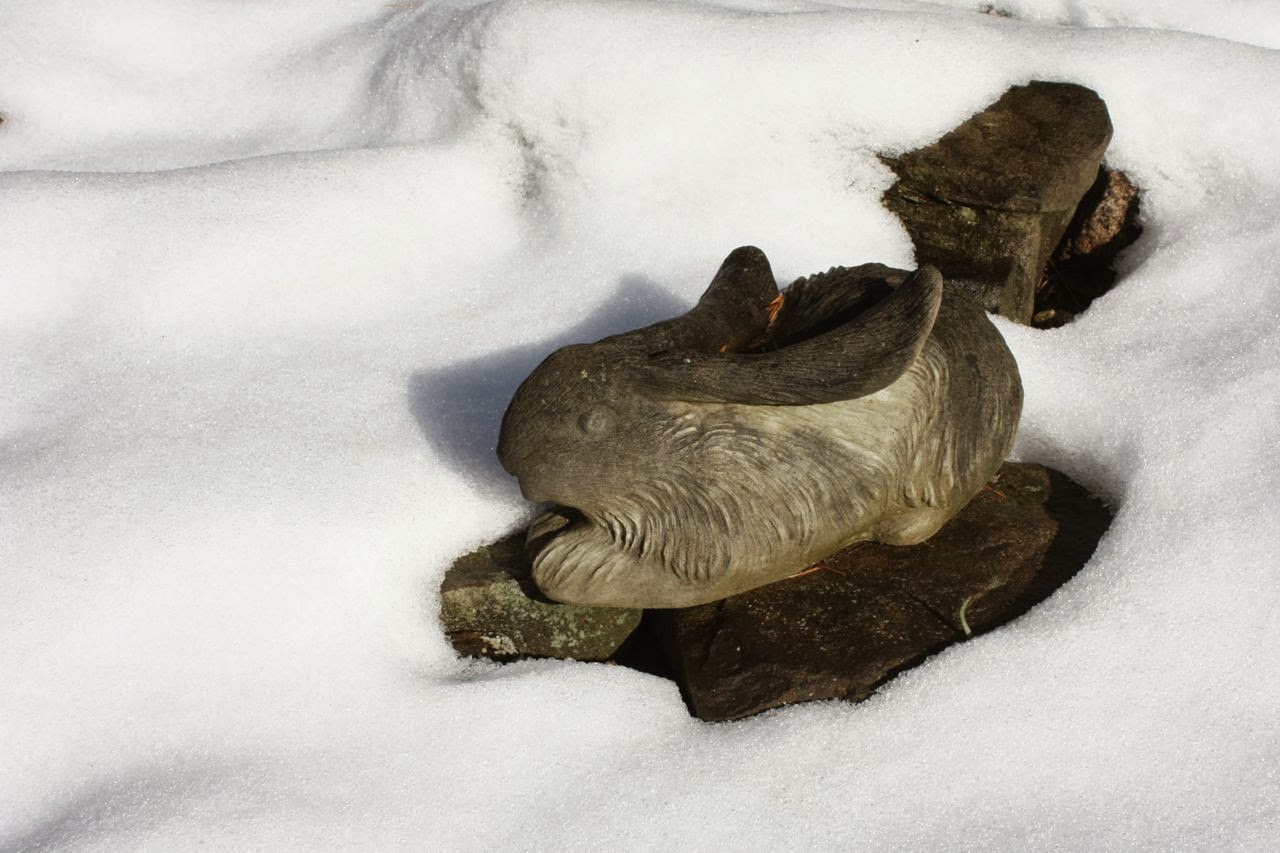
Concrete he may be, but rabbit is ready to break free of the snow.
Self-seeded Bright Lights Swiss Chard makes it through the snow unscathed and ready for picking.  This vegetable has been brightening up our meals right through the winter.
Aconites and snowdrops have been blooming for some time.  Narcissus has strong buds now just waiting for warmth to make them open.
Our coral bark maple is becoming more handsome with each year that passes and really comes into its own in the early spring when the young branches live up to its name.
Several piers japonica shrubs are sporting cascades of blossoms at this time of the year.
King Edward Flowering Currant blossoms emerge to warn us that Rufous Hummingbirds will soon be here to join the stalwart Anna's Hummingbirds which have been with us all winter.   Spring is truly peeking around the corner!

Friday, 17 January 2014

It's Spring in January

Today my mind is finally turning to the garden.  I've been studiously ignoring it all winter even though I know there are so many unfinished projects out there waiting for me.  We have had a little winter cold this year, but all in all, it's been pretty mild.  Only one snowfall which quickly disappeared.  There will be more - it's only January!  But this is what we come to expect on the West Coast - and in particular in the Gulf Islands.

Today I ordered my seeds from West Coast Seeds and T & T Seeds.  The latter was on my list because it was where I finally located Health Kick Tomato seeds.  My plea to West Coast Seeds went unrewarded!  That done, it was time to hit the garden.

I finally got the raspberries pruned and in shape.  They look very vigorous and this year I cut them about 5' tall.  Hopefully this will help to keep them in bounds.  As I headed up to the garden to dispose of the old canes I noticed that Abraham Darby (rose) is looking very fine!  He obviously is flourishing in his new home.  This rose has lost no leaves during the winter and there are even a few buds in evidence.  Then I saw how the King Edward Currant is breaking bud.  It was time to take a "spring signs tour"!
King Edward Currant buds getting ready to open
There are some plants I expect flowers from during the winter, so I grabbed my camera to take the census.
Viburnum flowers for the Anna's Hummingbirds we see in winter.
One of our viburnums (we have several varieties) starts blooming in November.  By January, it's starting to really show off its pink blossoms.
Purple Helebore
Then there's the purple hellebore that a neighbour gave me many years ago.  I planted it down below the house at the edge of the woods where it often gets forgotten.  It certainly never gets watered - or even weeded - but it seems to thrive down there and thrusts up its blossoms every year.  At this time of January, it's just getting going.
Hazelnut Catkins
We have 4 hazelnut bushes and the 2 older ones are dripping with catkins.  The 2 small ones are too young to have catkins yet, but they have a delicious secret hidden in their roots.  They've been inoculated with perigord truffle spores!  We can expect truffles in a couple of years.  When I edited the picture of the catkins (above) I notice you could make out the tiny dark pink flowers.  Look really hard - they're not easy to see!  Click on the picture to make it bigger, look where the catkin joins the branch and you'll see the flower.
Oriental Poppy
Oriental poppies are also sending up leaves at this time of the year.  This particular poppy is a pale pink one - name unknown.
Flat-leafed Italian Parsley Seedling
I've been picking herbs throughout the winter and the Italian parsley I planted a number of years ago freely sends its seeds out to create new plants.  It casts so many that I'm always pulling up plants but there are always more to help out the kitchen.
Bright Lights Swiss Chard
Tour finished, I picked a bouquet of Bright Lights Swiss Chard for tonight's dinner and headed in for a cup of tea.

Wednesday, 21 August 2013

Volunteers

In any sane, organized person's garden, volunteers are called weeds.  I certainly pull out my share of weeds and use mulches where I can to control them.  There is a definite place, however, in my garden for volunteers.

Foxgloves immediately come to mind when I think of weeds which are welcome to make my garden their home.  Unless they actually show up in a raised bed or the middle of a path, I leave foxgloves alone.  Their stately spires are a good food source for bees and I just think they look lovely.
Currant bush against the potting shed
The currant bush which has grown up against the potting shed is another volunteer.  It looks like a cross between the enormous King Edward bush below the potting shed and the currant bushes I gave up on in the garden as the birds nearly always got most of the crop.  My volunteer has blooms which are a darker pink than the King Edward, but produces berries which I leave for the chickadees and their fluttery babies.  Right now this bush is looking pretty motley because it was pruned back severely so we could install the UV light for the pond, but it won't take long to grow back again and its location means that it must be kept small.
Parsley gone to seed
The flat Italian parsley is another welcome plant in my garden.  I seeded this variety a number of years ago and it turns up regularly in a flowerbed above the pond.  I can nearly always find some parsley thanks to the freely-cast seeds of this useful plant.  Similarly, oregano appears all over the garden - mostly where I don't want it!  There's even a clump of it growing in a grassy area which sends up a delicious, spicy scent whenever it's mowed.
Bright Lights swiss chard growing in the snow pea bed
A couple of years ago, my neighbour Beth gave me some Bright Lights swiss chard plants.  My garden is pretty warm and this variety goes to seed quite easily which is why I generally don't grow it.  A recent weeding in the snow pea bed turned up a lot of little swiss chard plants, easily recognized by their colorful stems.  Some I transplanted to more open areas and others I left where they were growing.  Now that we're heading to fall, Bright Lights swiss chard will be a very useful addition to the winter garden.
Bright Lights in the strawberry bed
I even discovered a well-grown plant in the new strawberry bed!  Of course, I left it.
Beth's Big Fat Tomato
And naturally Beth's Big Fat Tomato was originally a volunteer.  I don't think my plant is producing tomatoes as big as the parent plant, but with a volunteer, you never know what you're going to get.  I do know, however, that this plant is very productive and the tomatoes are just starting to ripen.
Arugula going to seed
Several years ago, a friend gave me several small arugula plants from volunteers in her garden.  This is the wild arugula and of all the varieties of arugula, I like this one best.  It's everywhere in my garden, but quite easy to pull out.
A young arugula seedling popping up beside the snow peas
The bed that is now growing the fall crop of snow peas had the original arugula plants in it and any time the soil is turned over, thousands of little arugula plants appear!   And in my turn, I've passed along lots of little wild arugula plants as well.

I certainly have my share of weeds - chickweed, herb robert, snapweed, wild geranium and many others whose names I don't know - but many other so-called weeds, judiciously transplanted, are more than welcome to take up a spot in my garden.

Tuesday, 12 March 2013

Coming back to life

After almost 2 weeks of being under the the thumb of a particularly nasty virus I feel like it's not just the garden that's coming back to life!  We've had some lovely weather lately, but I've been unable to enjoy it.  Today is the first day that I've got enough energy to go outside and actually do a little.

The tomato seedlings have nearly all sprouted and most are over-ready to be in their new pots.  Today was supposed to be a day of torrential rain and wind, but happily the weatherman was wrong.  Taking advantage of a nice break in the weather, I took the seedlings out to the potting shed to move them into their new temporary homes.  As usual, I've grown more tomato plants than my needs require but there are always friends happy to take in a stray or two.  I was able to pot up 11 Bonny Best, 4 Gold Nugget and 6 Sweet Baby Girl.  I had planned on growing Stiletz as well, but when the time came to start the seeds, the package was nowhere to be found.  Principe Borghese, always a slow sprouter, was just breaking the soil, so they were brought back into the house to get a little stronger.  I'll look for another main crop tomato next time I'm near seed racks as there's still time to get them started.
Newly transplanted tomato seedling
I'm using up the last of my Quack Farm potting mix.  I've filled 4" pots with the mix, watered well and made a hole to receive the seedling.  I plant the seedlings deep.  This serves two purposes:  firstly, it shortens the stem of the plant so it doesn't become too weedy and secondly, the buried stem sends out roots and makes a stronger base for the plant.  When transplanted to their final spot, they can again be planted deeply.  Once in their new homes, the seedlings were covered by plastic domes to keep in heat and moisture.  Tomato plants need heat to germinate but can take much cooler temperatures for growing.  There's no need to make them too cool, however!  They'll keep the domes for a couple of weeks or so until they're well-established.

Each little pot is marked with a homemade plant tag.  I cut the tags from old yogurt containers and write the names on with a grease marker.  I used to use Jiffy Markers, but they fade.  When time came to plant the seedlings, sometimes I couldn't read the names anymore!  Grease markers stay bright for several seasons.
One tray full of seedlings ready for the plastic dome
Transplanting done, there was time to take advantage of sunshine forcing its way through the clouds and take a tour of the property.  And by the time I'd done that, I was pooped.  No more work today!
King Edward flowering currant almost ready for the hummingbirds
Dwarf narcissus beaded with recent rain

Rhubarb thrusting up through their leaf mulch
Three Sisters Bed patiently waiting for the next step


Sunday, 17 February 2013

Seeds Are Up!

This morning was beautiful and sunny - the kind of morning that you draws you outside.  And there were certainly no end of things that needed doing! First up, check the seedlings in the potting shed.
Seedlings - some potted up and others waiting to be planted outside
All my seedlings are currently in the potting shed.  A few days ago, I potted up some of the lettuce and mescalun seedlings.  Everything is doing fine.  Even the seedlings left in the original pots aren't wilted at all.  If you do it early enough, nothing suffers.  The extras will be potted up as well and go to my daughter and daughter-in-law.
Pots of carrot seeds
Then I filled some 4" pots with soil, wetted them down and carefully placed 9 seeds in each pot.  I learned this way of growing carrots at a workshop last year and it turned out so well, I'm definitely going to continue to grow carrots this way.  In my garden wood bugs eat the carrot seedlings as soon as they come out of the ground.  By seeding in pots and then planting the whole pot outside once the seeds have germinated and gotten a bit of growth, they survive the wood bugs.  I planted 3 varieties today - Bolero, Scarlet Nantes and Mokum, a new Imperator variety. It's a bit fiddly seeding this way, but there's no thinning later on and you can pull up the whole bunch for dinner.  I will be doing more carrot pots, of course.

We also created a new bed in our deer-proof fenced area so we can transplant a much-loved rose.  Abraham Darby is a truly wonderful David Austin rose.  The big, beautiful flowers are strongly scented and the plant itself was a parting gift from fellow staff members when I moved locations.
Abraham Darby Rose
We stripped away the sod from the target area below the pond where we will be able to see the rose from the house.  My husband dug a pit about 2' deep and we built up around the new bed with rocks - of which we have an abundance on our Gulf Island property!  I filled the hole with a mixture of garden soil and compost and then the rest of the bed was completed with sieved soil from the digging mixed with more garden soil.  Another day we'll move the rose.

After a few more chores - planting radishes in the garden and putting compost on a vegetable bed which I'd spaded over, there was time to check for more spring signs.
Fordhook Swiss Chard planted last year is sending up new growth
King Edward Flowering Currant buds bursting open - Rufous Hummingbirds will soon be here!
Coral Bark Maple branches flaming in the spring sunshine


Sunday, 10 February 2013

Aconite, Snowdrop - and Chicken!

I was out in the garden this morning (February 10th) picking parsley for my latest favorite recipe (to follow!) and couldn't help noticing the signs of spring popping up everywhere.  The earliest in my garden are always winter aconites and snowdrops.  I don't count the viburnum which blooms all winter long!

Galanthus nivalis - the common snowdrop
My favorite snowdrops are the little Galanthus nivalis - the common snowdrop.  There are showier ones, but none in my estimation can beat plain, old common snowdrops.  The best way to get them established in your garden, I've discovered, is to get a friend to give you a clump when they're in bloom.  I've tried many times to get them to grow from bulb without much success.
Eranthis - winter aconite
Another favorite spring flower is the winter aconite.  Like the snowdrop, it's usually in bloom in February.  In my garden, it pushes up through the dead foliage of a Japanese iris (I'm not called The Messy Gardener for nothing!)  The flowers in the picture aren't open because there's no sun today, but the hint of warmth will make them burst into full glory.
A third sign of spring is that the buds on my King Edward flowering currant are starting to open.  These are even earlier than the native currants and always bring the Rufous Hummingbirds.  This year, I won't know if I'm seeing Rufous or Anna's Hummingbirds as the females look so alike.  Today I saw my first male Anna's.  He's unmistakable with his scarlet head, very unlike the Rufous male.

But today I went out to pick parsley.  The flat Italian parsley grows all year long in my garden, so off I went to get some for Chicken with Gremolata Crust.  I count it as a recipe from my garden because it contains the parsley and garlic that I grow.  And it's absolutely delicious!

Chicken with Gremolata Crust

4 whole chicken legs with thigh attached (or any chicken pieces)
2/3 cup breadcrumbs
1/4 cup freshly grated parmesan cheese
3 Tbsp chopped fresh parsley
2 tsp finely grated lemon zest
1 to 2 large garlic cloves minced
1/2 tsp paprika
pinch cayenne pepper
2 Tbsp mayonnaise
1 Tbsp Dijon mustard
salt & freshly ground pepper to taste

Preheat the oven to 375 degrees F.  Line a large baking sheet with parchment paper.

Combine the breadcrumbs, cheese, parsley, lemon zest, garlic, paprika and cayenne in a wide, shallow dish.

Combine the mayonnaise and mustard in a bowl large enough to hold the chicken.  Add the chicken and toss to coat. (I usually just smear the mayonnaise/mustard on with my hands!)

Then coat in breadcrumb mixture.  Season with salt and pepper.  Bake 50 minutes or until cooked through.

Tonight I'm serving this with rice cooked in chicken broth and cole slaw with chunks of apple and grated carrot.  Yum!