Today I bought the potatoes for my potato grow bags. I managed to find German Butter Potatoes which are a delicious yellow potato - just perfect for potato salads. Most of the resources I consulted regarding potato grow bags suggested 4 or 5 potatoes per bag but that sounds like a lot to me.
I planted 3 potatoes per bag. As they're small, I didn't cut them; just planted them whole with the strongest spouts at the top about 6" deep, then smoothed the soil over the top. When they get about 6" high above the soil, I'll start adding more material to the bags.
Then I checked out the first potatoes I planted in one of the 4x4 concrete beds and they're up!
And just because it's spring and it's a beautiful day outside, I snapped some of my favourite narcissus flowers. I thought they were called Grandma's Hat, but after looking them up, I've no idea what they are. But they're definitely beautiful!
Showing posts with label narcissus. Show all posts
Tuesday, 1 April 2014
Friday, 28 February 2014
Never Doubt
No seeds have thrust above the potting soil yet, but spring is definitely on the way.
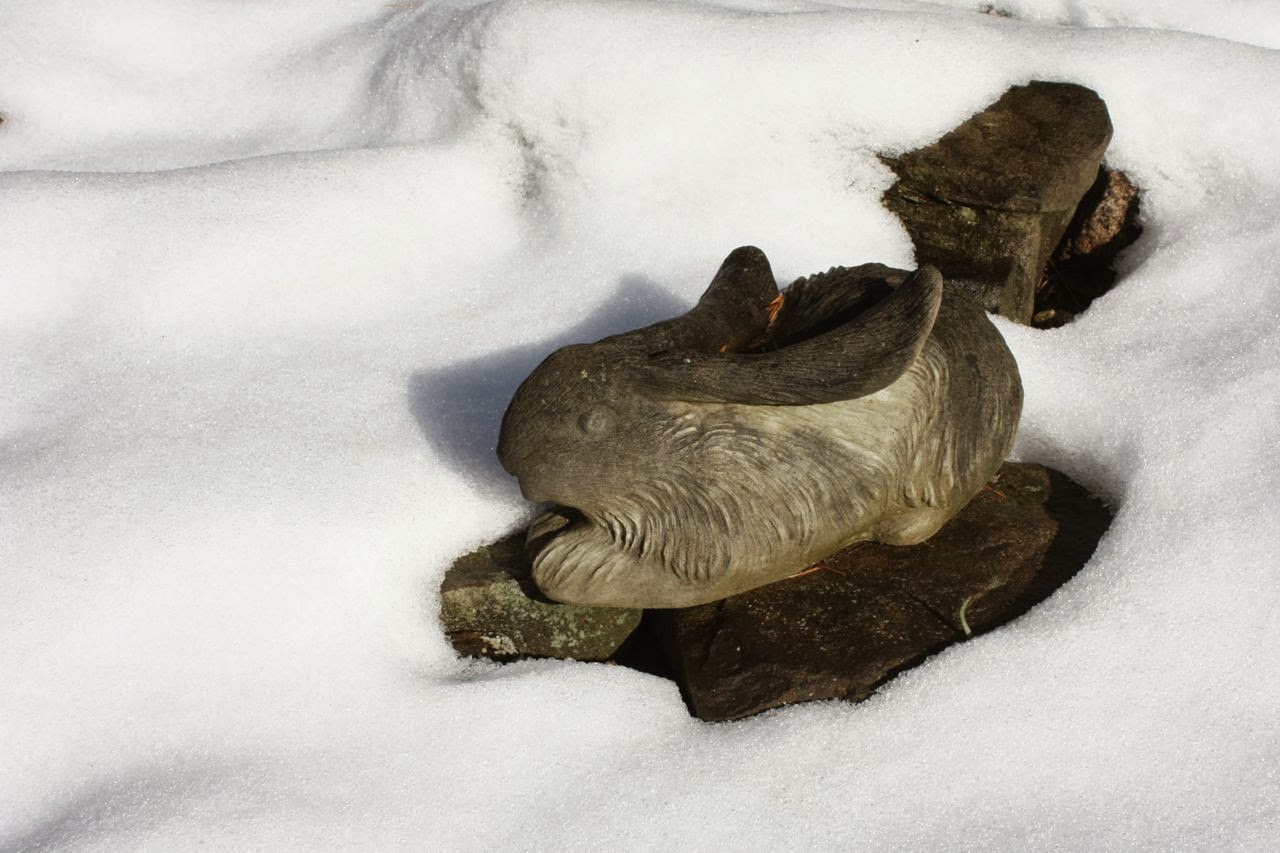
Concrete he may be, but rabbit is ready to break free of the snow.
Self-seeded Bright Lights Swiss Chard makes it through the snow unscathed and ready for picking. This vegetable has been brightening up our meals right through the winter.
Aconites and snowdrops have been blooming for some time. Narcissus has strong buds now just waiting for warmth to make them open.
Our coral bark maple is becoming more handsome with each year that passes and really comes into its own in the early spring when the young branches live up to its name.
Several piers japonica shrubs are sporting cascades of blossoms at this time of the year.
King Edward Flowering Currant blossoms emerge to warn us that Rufous Hummingbirds will soon be here to join the stalwart Anna's Hummingbirds which have been with us all winter. Spring is truly peeking around the corner!
Concrete he may be, but rabbit is ready to break free of the snow.
Self-seeded Bright Lights Swiss Chard makes it through the snow unscathed and ready for picking. This vegetable has been brightening up our meals right through the winter.
Aconites and snowdrops have been blooming for some time. Narcissus has strong buds now just waiting for warmth to make them open.
Our coral bark maple is becoming more handsome with each year that passes and really comes into its own in the early spring when the young branches live up to its name.
Several piers japonica shrubs are sporting cascades of blossoms at this time of the year.
King Edward Flowering Currant blossoms emerge to warn us that Rufous Hummingbirds will soon be here to join the stalwart Anna's Hummingbirds which have been with us all winter. Spring is truly peeking around the corner!
Friday, 22 March 2013
Making It Count
When you don't have a lot of soil - or a lot of room - you have to make every bit count. Our vegetable garden is in the sunniest spot on our treed 2-acre lot. That also happens to be at the top of a rocky plateau with nearby cedars. This is why our garden is mostly composed of concrete raised beds. The concrete beds have concrete bottoms and the drainage is above ground so the hungry cedar roots can't get in. When you garden in raised beds, you are concentrating the nutrition you add to the garden and the soil is loose because you aren't walking on it. Because your nutrition is concentrated, you can grow a lot more in a small space than if you were growing straight into the ground.
The original part of our vegetable garden was 2 wood-sided beds plus 2 pits that we grow asparagus in. The wooden beds are starting to rot now and we will put concrete sides on them to create one large Three Sisters bed. The wide side of the "vee" between the beds is walled with tires. Unfortunately there is the top of a monster rock in the middle of the "vee" so there isn't a lot of soil depth. It'll do, though, for the squash component of the bed. I can grow zucchini in the tires.
We have used tires elsewhere in the garden as well. Stacked 2 high and filled with rich soil, they create a container that I will grow cherry tomatoes in. There are also 2 half-barrels that will also be used for cherry tomatoes.
In addition to the raised beds, on the north side of the plateau lies what was supposed to be the rose bed. It has now become the rhubarb bed! The soil here needs lots of building for the 6 rhubarb clumps. Each spring, I add compost to the plants and then heap on a thick layer of unshreaded maple leaves. The maple leaves smother any weeds which have plans to take over and the leaves rot into the soil. This will take time, but eventually the rhubarb will have the kind of soil it needs.
Of course flowers have a place in my garden - it's not all practical stuff! The central bed in the garden contains perennials - peonies, delphiniums, day lilies, phlox, as well as spring bulbs - narcissi, tulips, hyacinths and self-seeded windflowers and grape hyacinths. There was an arbutus tree in the middle, but this winter we removed it. There will be a lot more sun for the beds to the north now.
We have also tried growing blueberries, black currants, tay berries and raspberries on the plateau but the lack of soil made it very unsuccessful. They have now all been removed. Off the back of the plateau we have 2 large hazelnut bushes which are producing nicely. A couple of years ago, we added 2 more hazelnuts, the roots of which have been inoculated with Perigord truffle spores. In a couple of years, we might be digging up truffles!
The point of all this is to demonstrate that you might not have a lot of room, but with raised beds and some creative thinking you'd be amazed at how much you can grow!
The original part of our vegetable garden was 2 wood-sided beds plus 2 pits that we grow asparagus in. The wooden beds are starting to rot now and we will put concrete sides on them to create one large Three Sisters bed. The wide side of the "vee" between the beds is walled with tires. Unfortunately there is the top of a monster rock in the middle of the "vee" so there isn't a lot of soil depth. It'll do, though, for the squash component of the bed. I can grow zucchini in the tires.
![]() |
| The original wooden beds which become the Three Sisters bed |
![]() |
| Make-do containers for cherry tomatoes |
![]() |
| Almost the entire garden. |
We have also tried growing blueberries, black currants, tay berries and raspberries on the plateau but the lack of soil made it very unsuccessful. They have now all been removed. Off the back of the plateau we have 2 large hazelnut bushes which are producing nicely. A couple of years ago, we added 2 more hazelnuts, the roots of which have been inoculated with Perigord truffle spores. In a couple of years, we might be digging up truffles!
The point of all this is to demonstrate that you might not have a lot of room, but with raised beds and some creative thinking you'd be amazed at how much you can grow!
Tuesday, 12 March 2013
Coming back to life
After almost 2 weeks of being under the the thumb of a particularly nasty virus I feel like it's not just the garden that's coming back to life! We've had some lovely weather lately, but I've been unable to enjoy it. Today is the first day that I've got enough energy to go outside and actually do a little.
The tomato seedlings have nearly all sprouted and most are over-ready to be in their new pots. Today was supposed to be a day of torrential rain and wind, but happily the weatherman was wrong. Taking advantage of a nice break in the weather, I took the seedlings out to the potting shed to move them into their new temporary homes. As usual, I've grown more tomato plants than my needs require but there are always friends happy to take in a stray or two. I was able to pot up 11 Bonny Best, 4 Gold Nugget and 6 Sweet Baby Girl. I had planned on growing Stiletz as well, but when the time came to start the seeds, the package was nowhere to be found. Principe Borghese, always a slow sprouter, was just breaking the soil, so they were brought back into the house to get a little stronger. I'll look for another main crop tomato next time I'm near seed racks as there's still time to get them started.
I'm using up the last of my Quack Farm potting mix. I've filled 4" pots with the mix, watered well and made a hole to receive the seedling. I plant the seedlings deep. This serves two purposes: firstly, it shortens the stem of the plant so it doesn't become too weedy and secondly, the buried stem sends out roots and makes a stronger base for the plant. When transplanted to their final spot, they can again be planted deeply. Once in their new homes, the seedlings were covered by plastic domes to keep in heat and moisture. Tomato plants need heat to germinate but can take much cooler temperatures for growing. There's no need to make them too cool, however! They'll keep the domes for a couple of weeks or so until they're well-established.
Each little pot is marked with a homemade plant tag. I cut the tags from old yogurt containers and write the names on with a grease marker. I used to use Jiffy Markers, but they fade. When time came to plant the seedlings, sometimes I couldn't read the names anymore! Grease markers stay bright for several seasons.
Transplanting done, there was time to take advantage of sunshine forcing its way through the clouds and take a tour of the property. And by the time I'd done that, I was pooped. No more work today!
The tomato seedlings have nearly all sprouted and most are over-ready to be in their new pots. Today was supposed to be a day of torrential rain and wind, but happily the weatherman was wrong. Taking advantage of a nice break in the weather, I took the seedlings out to the potting shed to move them into their new temporary homes. As usual, I've grown more tomato plants than my needs require but there are always friends happy to take in a stray or two. I was able to pot up 11 Bonny Best, 4 Gold Nugget and 6 Sweet Baby Girl. I had planned on growing Stiletz as well, but when the time came to start the seeds, the package was nowhere to be found. Principe Borghese, always a slow sprouter, was just breaking the soil, so they were brought back into the house to get a little stronger. I'll look for another main crop tomato next time I'm near seed racks as there's still time to get them started.
![]() |
| Newly transplanted tomato seedling |
Each little pot is marked with a homemade plant tag. I cut the tags from old yogurt containers and write the names on with a grease marker. I used to use Jiffy Markers, but they fade. When time came to plant the seedlings, sometimes I couldn't read the names anymore! Grease markers stay bright for several seasons.
![]() |
| One tray full of seedlings ready for the plastic dome |
![]() |
| King Edward flowering currant almost ready for the hummingbirds |
![]() |
| Dwarf narcissus beaded with recent rain |
![]() |
| Rhubarb thrusting up through their leaf mulch |
![]() |
| Three Sisters Bed patiently waiting for the next step |
Thursday, 21 February 2013
Three Sisters Garden - Part I
On the weekend, I was talking gardening with my daughter and daughter-in-law. I told them about a long Three Sisters Garden that Jollity Farm had planted. A Three Sisters Garden is a native indian creation. It combines corn, beans and squash in a harmonious companion planting. The corn is planted first and when it's about 4" tall, the climbing beans and squash are planted. Corn provides the framework for beans to grow on and the beans provide strength to keep the corn from being blown over. Beans add nitrogen to the soil which corn needs. Squash covers the ground, crowding out weeds, keeping in moisture and repelling marauding raccoons with its prickly vines. Similarly, corn and beans together are almost a perfect food. This garden can continue in the same place for many, many years without crop rotation, maintaining its fertility with the happy blend of plants and their products composted and put back on the soil.
This got me thinking. I'd grown corn and beans together many years ago when I was just getting started gardening. The experiment wasn't particularly successful but I think in light of some of the things I've learned about gardening and soil health over the years, I'm ready to try it again.
This kind of garden needs some room and the kind of raised bed gardening I've been doing doesn't quite fit. I do, however, have the oldest section of my garden which has two wood framed 4x6 raised beds that are nearing their end as the wood is finally rotting. If I take them over, I can turn this whole area into my Three Sisters Garden. Eventually, I'll remove the wood from the beds and face the area with rocks, but for now, I'll just make do.
Here's the "Before" picture. There are still leeks growing in one bed and for the time being I'll leave them be. This is February, after all, and I won't need the bed for a few months yet. In the meantime, I can tidy up!
Now the beds are dug over (except for the leeks). The tires in between the beds are filled with soil and were used to grow cherry tomatoes in. I'll take them away and fill in the area between the beds with soil as well. This weekend, I have a yard of SeaSoil coming and some of this will be generously added to the beds.
For more information on Three Sisters Gardening, check out the Renee's Garden website, which explains it clearly, offering plans and seeds.
All that's left for this post is to show the latest signs of spring!
This got me thinking. I'd grown corn and beans together many years ago when I was just getting started gardening. The experiment wasn't particularly successful but I think in light of some of the things I've learned about gardening and soil health over the years, I'm ready to try it again.
This kind of garden needs some room and the kind of raised bed gardening I've been doing doesn't quite fit. I do, however, have the oldest section of my garden which has two wood framed 4x6 raised beds that are nearing their end as the wood is finally rotting. If I take them over, I can turn this whole area into my Three Sisters Garden. Eventually, I'll remove the wood from the beds and face the area with rocks, but for now, I'll just make do.
![]() |
| Before |
![]() |
| After tidy-up |
For more information on Three Sisters Gardening, check out the Renee's Garden website, which explains it clearly, offering plans and seeds.
All that's left for this post is to show the latest signs of spring!
![]() |
| Salome Narcissus |
![]() |
| Purple Hellebore planted in the forested area of our property |
Subscribe to:
Posts (Atom)